Taiwan Exosome Company (TEC) Partners with ATRI to Obtain "SPF Pig Platelet Exosome" Licensing, Targeting Billion-Dollar Global Regenerative Medicine Opportunities
Taiwan Exosome Company (TEC) Partners with ATRI to Obtain Authorization for "SPF Porcine Platelet-Derived Exosomes," Positioning for Billion-Dollar Global Regenerative Medicine Opportunities
(Reported by Zhang Yun-xuan)
Taiwan Exosome Company (TEC) announced today that it has formally completed a key technology authorization and strategic cooperation agreement with the Agricultural Technology Research Institute (ATRI). This partnership successfully breaks through three major bottlenecks of xenogeneic exosomes—biosafety, mass production stability, and application feasibility—by obtaining the authorization for "SPF Porcine Platelet-Derived Exosome Isolation Technology" and simultaneously launching a joint development project for "SPF Porcine NK Cells and Their Exosomes." This milestone not only establishes a global leading advantage in integrating human, plant, and SPF porcine triple-source exosome R&D and pharmaceutical platforms but also opens up high-potential commercial opportunities worth billions in the Taiwanese, Japanese, and global regenerative medicine, immunotherapy, and high-end medical beauty markets.
High Standards for Biosafety! A Critical Breakthrough for SPF Porcine Xenogeneic Exosomes Moving Toward Clinical Use
The core of this cooperation lies in the national-level "Specific Pathogen Free (SPF)" pig breeding system long established by ATRI, which complies with international standards. The pigs are raised throughout in highly isolated and monitored environments with complete health records and traceability. This directly aligns with the regulatory requirements of the US FDA, Japan's PMDA, and Taiwan's TFDA for xenogeneic cell and exosome raw material sources, deploying in advance to assist manufacturers in successfully obtaining product certification. Compared to traditional cell sources, SPF pigs demonstrate two key advantages:
High-Standard Biosafety: Reduces the risk of zoonotic diseases, addressing the most critical safety concern long associated with xenogeneic applications.
High Physiological Similarity: Pigs are highly similar to humans in tissue structure, immune response, and cell signaling, giving their exosomes greater potential for research translation and application.
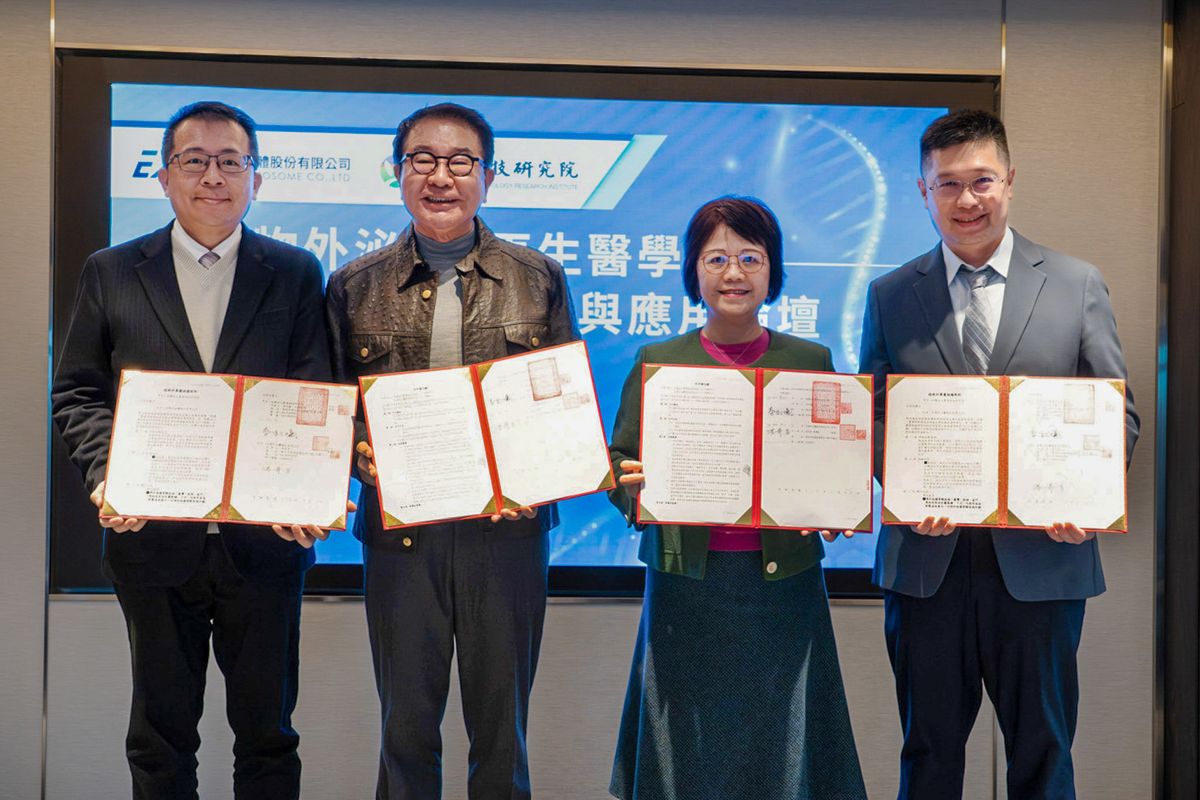
Photo / Hung Chi-chang, Chairman of Taiwan Exosome Company (front row, fourth from left), and Li Hong-xi, Acting President of the Agricultural Technology Research Institute (front row, third from right), lead both teams in a commemorative photo, symbolizing the deepening cooperation and promotion of industrial-research exchange between the two parties in the fields of exosomes and regenerative medicine. (Provided by Taiwan Exosome Company)
Platelet-Derived Exosomes: A New Driver for Regenerative Medicine R&D without Cell Culture and Capable of Mass Production
Through high-purity isolation technology independently developed by ATRI, combined with an AI platelet quality inspection system, a "SPF Porcine Platelet-Derived Exosome" manufacturing process that achieves stable mass production without cell culture has been successfully established. This major technical breakthrough significantly reduces manufacturing costs and variation risks while retaining high concentrations and active ingredient compositions, possessing high potential for industrialization.
According to preliminary research data from ATRI, SPF porcine platelet-derived exosomes showed improvements across multiple regeneration indicators:
Skin Tissue Repair Related Research IndicatorsShowed difference compared to control group (72%)
Hair Related Research IndicatorsShowed difference compared to control group (68%)
Inflammation Related Research IndicatorsShowed difference compared to control group (approx. 45%)
(The above are preliminary research indicators and do not represent efficacy or therapeutic effects on the human body)
Based on the above results, a concrete and verifiable scientific foundation is provided for its introduction into high-end medical beauty, post-operative care, skin care, and scalp maintenance markets.
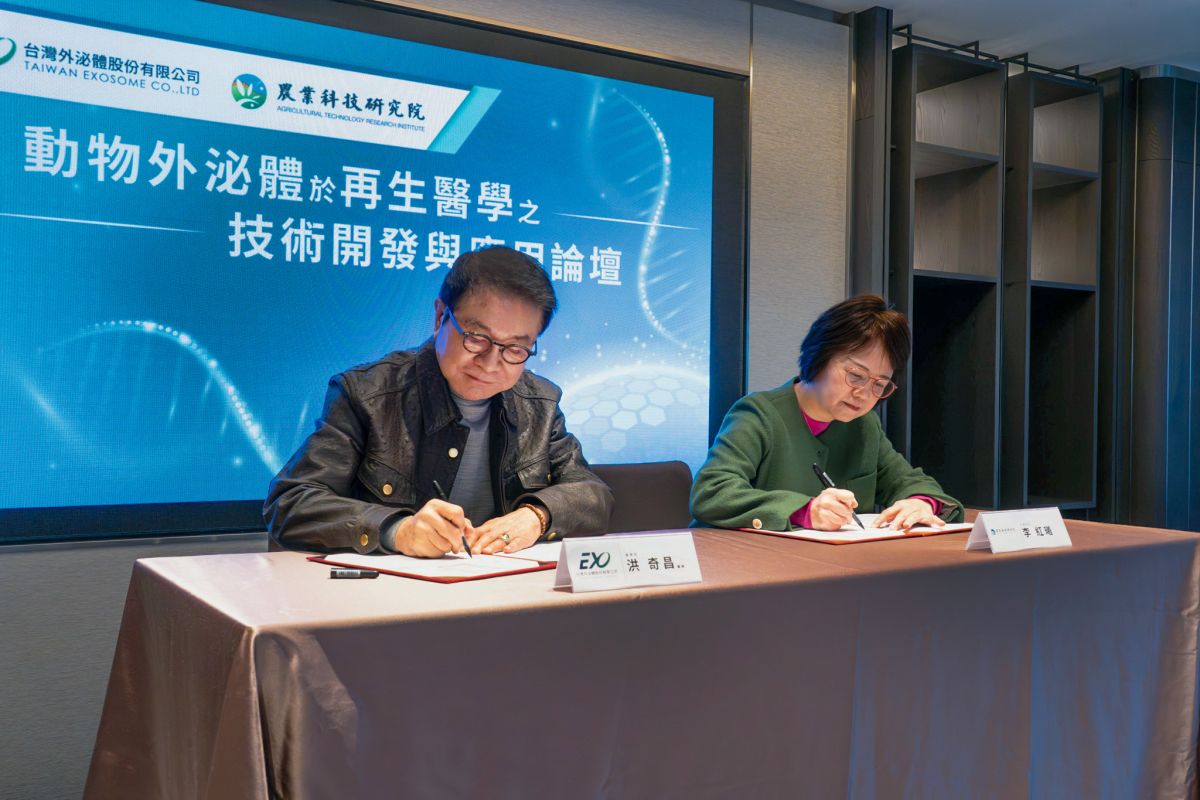
Photo / Hung Chi-chang, Chairman of Taiwan Exosome Company (left), and Li Hong-xi, Acting President of the Agricultural Technology Research Institute (right), completed the signing during the cooperation ceremony, officially launching the collaboration between the two parties in exosome-related technologies and applications. (Provided by Taiwan Exosome Company)
NK Cells and Exosomes: Cross-Domain Agricultural-Medical Cooperation to Build an All-in-One Immune-Related Industry Application Ecosystem
In addition to platelet-derived exosomes, the two parties have further targeted "NK cells (Natural Killer cells) and their exosomes" as the core R&D focus for the next stage. Compared to the currently high-cost and complex CAR-T cell therapy, SPF porcine-derived NK exosomes demonstrate three key commercial advantages:
Controllable Costs and Scalable Production: Significantly lowers the threshold for advancing immune-related application research and market introduction.
Logistics and Preservation Advantages: Exosomes are more stable than live cells, facilitating cold chain transportation and global supply.
Broad Application Potential: Possesses evidence-based medical application research in immune regulation and oncology.
Taiwan Exosome Company will combine ATRI's internationally certified animal testing capabilities (hardware and software) with its own established clinical-grade NK cell process technology, aiming to gradually build core key technologies from "SPF source and exosome process to clinical application" within one year.
Both parties took a commemorative photo after the signing. From left: Dr. Lin Chieh-liang, COO and CTO of Taiwan Exosome Company; Chairman Hung Chi-chang; Li Hong-xi, Acting President of the Agricultural Technology Research Institute; and Dr. Yang Chi-yu, Deputy Director of the Institute of Agricultural Materials and Value-added. (Provided by Taiwan Exosome Company)
Three-Stage Layout from Clinical Application to Global Opportunities
In response to the rapid growth of global aging and regenerative medicine needs, Taiwan Exosome Company will launch a three-stage global regenerative medicine market layout strategy:
Phase 1 | Deepening in Taiwan Enter the medical beauty, regenerative repair, and high-end maintenance markets with SPF porcine platelet-derived exosome products to accumulate revenue and brand reputation.
Phase 2 | Expanding to Japan Japan is the world's most aged market with mature regenerative medicine regulations. The company established a Japanese subsidiary in 2025, expects to submit clinical trial applications in 2026, and achieve commercialization between 2029 and 2030.
Phase 3 | Global Layout Using Japan as the foundational first stop, continue to expand into European and American markets, aiming to establish a global operating system by 2030 and planning to list on the US NASDAQ.
With the advancement of the Japanese market and the rollout of immunotherapy product lines, five-year revenue is expected to challenge NT$350 million, with an anticipated internal rate of return (IRR) exceeding 30%.
Hung Chi-chang, Chairman of Taiwan Exosome Company, stated: "This cooperation is not just a single technological breakthrough, but allows Taiwan's biotech industry to truly master the core key technologies from the raw material source and manufacturing process to clinical application." He looks forward to making Taiwan shine in the global regenerative medicine and immune-related application fields through the innovative "Taiwan Exosome Triple-Source Technology Platform," providing high-quality domestic medical products to give back to societal needs.